
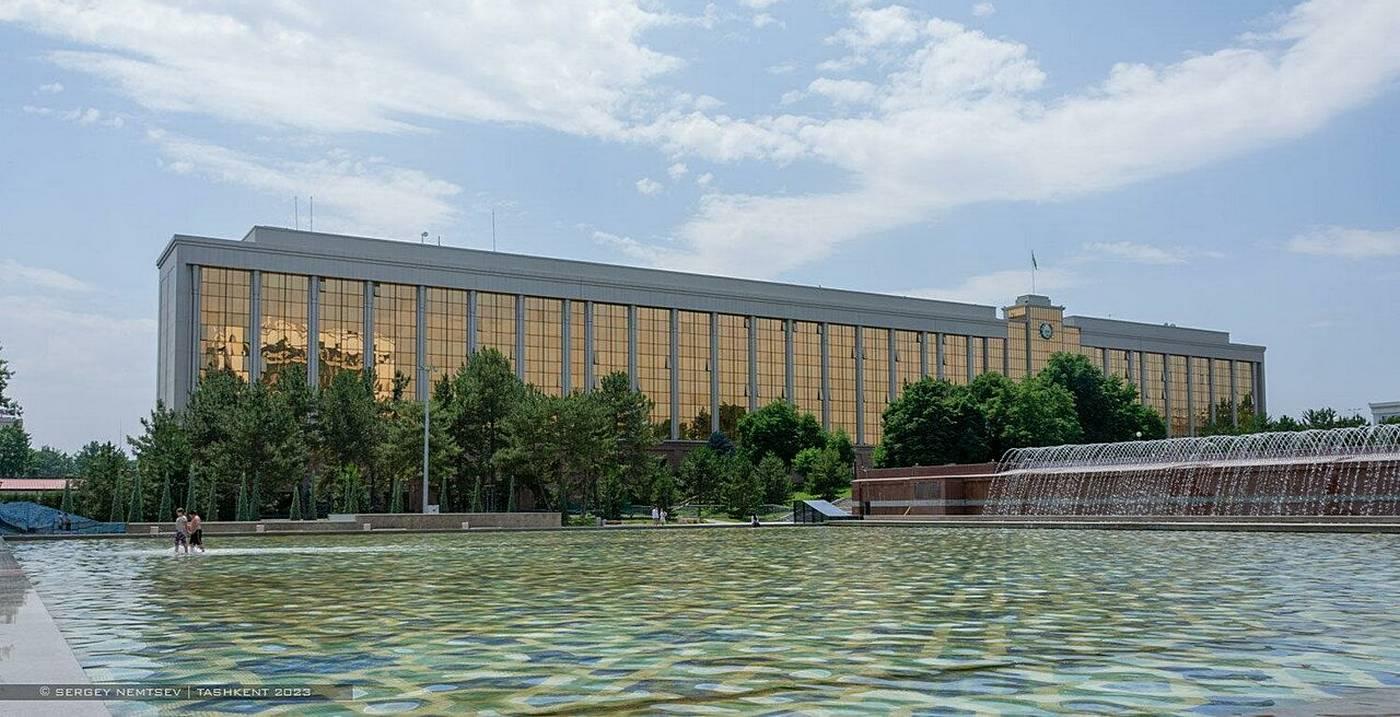
Mustaqillik Square acquired its main features after the 1966 earthquake, when the former Red Square was enlarged more than threefold. However, transformations had begun even earlier: in 1965 construction started on a new, modern (for its time) Council of Ministers building raised above the foundation on V-shaped supports.
In 1970 construction began on the
high-rise “House of Ministries” decorated with a rectangular sun-shading
lattice (panjara). Adjacent to it was the “Iskra” cinema with a flat horizontal
layout.
The architects of the Parade Alley and
Lenin Square (Ye. Rozanov, B. Mezentsev, B. Zaritsky, V. Shestopalov, A.
Yakushev, and L. Adamov; engineers V. Krichevsky, T. Melik-Arakelyan, N.
Nikitin, Yu. Kozel, A. Kolotiev, and Z. Muftakhov) created one of the largest squares
in the former USSR, complete with fountains, flowerbeds, and tree-lined
avenues.
In the early 21st century the appearance
of Mustaqillik Square was altered: the wide parade route was narrowed, part of
it turned into green areas, the ministries high-rise was “shortened” by 6
floors, and instead of the lattice it received aluminium composite panels and
dark glazing.
The brutalist Cabinet of Ministers
building was damaged during the events of 16 February 1999. During
reconstruction the supports were enclosed and the façade was clad in
gold-tinted glass, leaving the architects’ original concept in the past.
At the end of the 19th century, two orphanages operated in Tashkent — the Alexandrovsky and the Kau...
The Central Telegraph building is one of the most beautiful in Tashkent. It is part of the “Stalin-...
The beautiful building with a semi-circular facade was constructed in 1938 by Moscow architects A. ...
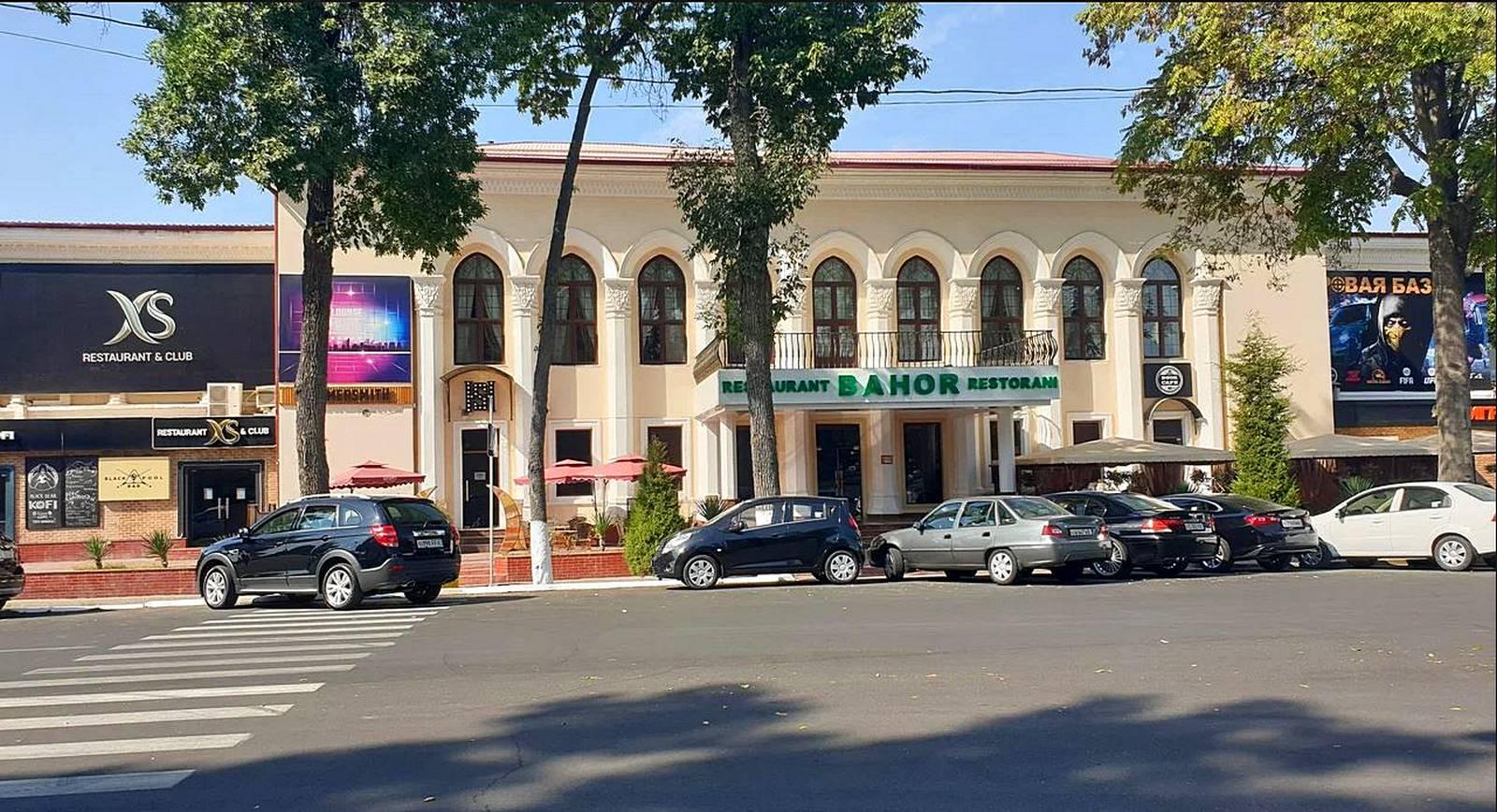
The “Bahor” restaurant is one of Tashkent’s first banquet halls, built in 1958 according to the des...